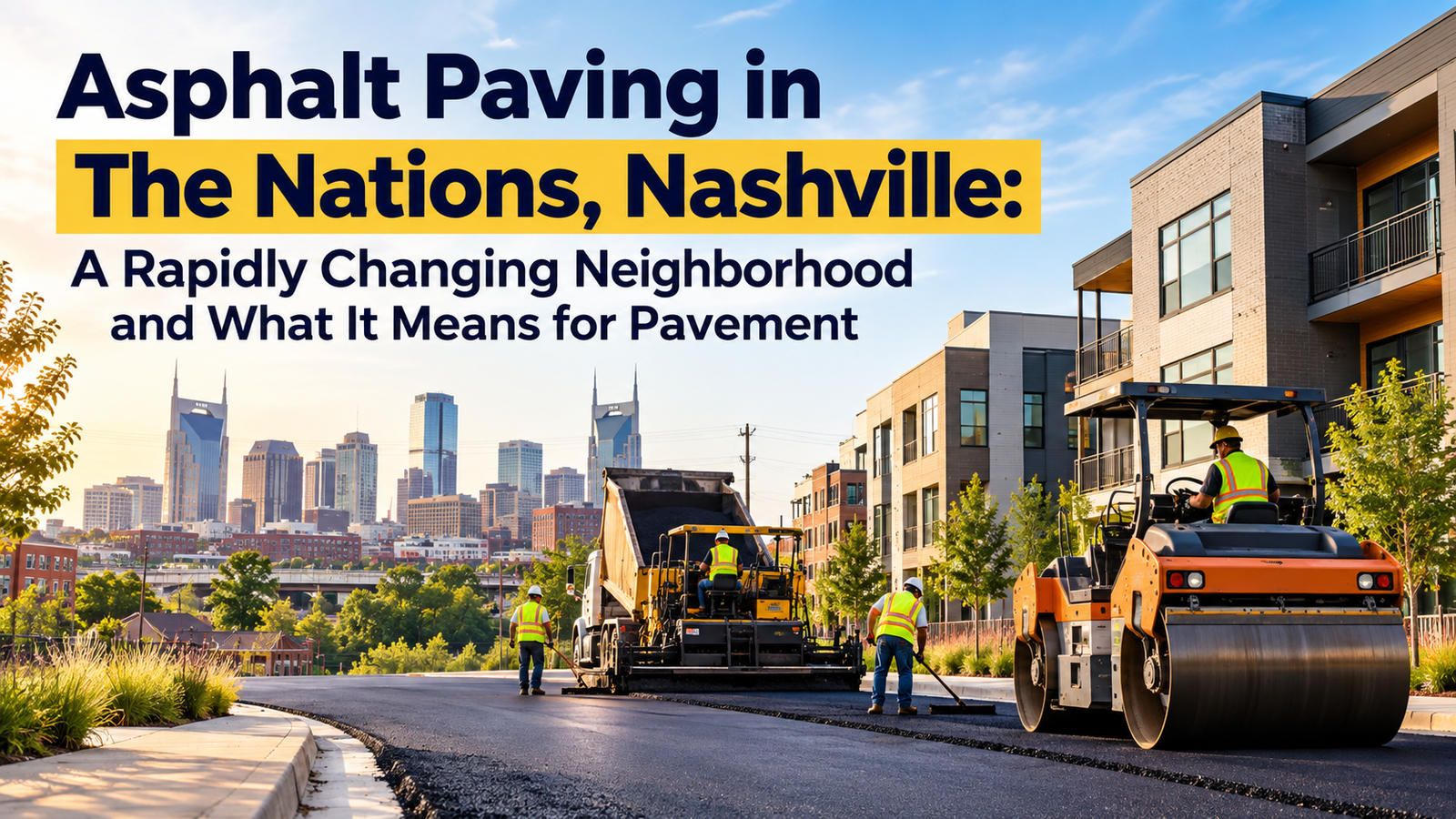
The Nations is one of Nashville’s most rapidly transformed neighborhoods. Located west of downtown across the Cumberland River, roughly bounded by 51st Avenue North, Charlotte Avenue, 40th Avenue North, and Centennial Boulevard, The Nations shifted from a working-class industrial and residential neighborhood into one of the city’s most active development corridors over the course of the 2010s. New multifamily residential buildings, restaurant and retail concepts, mixed-use developments, and townhouse projects arrived in rapid succession, layering new construction over a neighborhood fabric that still includes older single-family housing, small industrial uses, and commercial strips.
This development intensity creates a pavement environment with specific characteristics. New residential and commercial developments need well-designed parking lots and access drives. Older properties in the neighborhood may have aging Asphalt Contractor The Nations driveways that have not been maintained in years. The street grid in parts of The Nations was not designed for the traffic volumes now using it. Understanding the pavement demands of this specific neighborhood its soil conditions, its climate exposures, and its mix of old and new construction contexts is the starting point for professional asphalt work here.
The Physical Character of The Nations and Its Soil Conditions
The Nations occupies relatively flat terrain west of the downtown core, near the confluence of Richland Creek and the Cumberland River. The area’s geology reflects Nashville’s broader position on the Nashville Dome, with Ordovician limestone underlying residual soils. In the lower-elevation areas near Richland Creek, alluvial deposits of silt and clay introduce fine-grained, moisture-sensitive soils that require careful subgrade management in pavement applications.
The rapid pace of development in The Nations has introduced significant grading activity across many parcels. Cut and fill operations associated with new construction alter the natural soil profile and, when not properly documented and compacted, create variable subgrade conditions beneath new pavement. New parking lots and driveways installed on recently filled areas require proof-rolling a compaction verification technique using a loaded dump truck to identify soft spots before asphalt is placed.
Older sections of The Nations, particularly the residential blocks west of 51st Avenue, have the clay-bearing residual limestone soils typical of the Nashville Basin. These soils shrink and swell with seasonal moisture changes, and pavement founded on them without adequate aggregate base separation is prone to differential settlement and cracking that follows the drying and wetting cycles of the Tennessee climate.
Tennessee Climate: Heat, Rain, and Freeze-Thaw in The Nations
The Nations experiences the same humid subtropical climate as the rest of Nashville. Summers are hot and humid, with pavement surface temperatures regularly exceeding 130 to 140 degrees Fahrenheit on sunny July and August afternoons. These temperatures soften the asphalt binder and make newly paved surfaces vulnerable to rutting under heavy loads. The PG 76-22 performance-graded binder used in Nashville surface mixes is specified to maintain stiffness at these elevated temperatures while also providing cold-temperature flexibility down to -22 degrees Celsius.
Annual precipitation in Nashville averages around 47 inches, and the pattern in The Nations where new impervious surfaces from dense development have altered natural drainage patterns means that stormwater management is as important a consideration in pavement design as load capacity. Parking lots and driveways must be graded to drain water off the surface rather than allowing ponding. Where the natural grade is flat, minimum two-percent cross-slopes are designed into the pavement surface to ensure runoff moves to collection points.
Winter freeze-thaw events in Nashville cross the freezing threshold frequently enough to damage unprotected pavement. Unlike northern cities where the ground freezes deeply and stays frozen for months, Nashville’s winters produce repeated shallow freeze-thaw cycles. Each cycle expands water in existing cracks slightly, widening them incrementally. The seasonal accumulation of these incremental openings converts surface cracks into structural failures if maintenance is deferred.
Parking Demand and Pavement Design in The Nations’ Development Boom
The rapid addition of new multifamily residential buildings and mixed-use developments in The Nations has increased parking demand significantly. Off-street parking lots serving new developments are designed to Nashville Metro zoning code requirements and must meet standard pavement specifications for the anticipated vehicle types. Parking structures associated with larger developments are outside the scope of standard asphalt paving, but the surface lots and access drives connecting to those structures are not.
New parking lot installations in The Nations typically specify a structural section appropriate for light-duty passenger vehicles: four to five inches of compacted Tennessee Class A aggregate base over prepared subgrade, topped with two inches of binder course asphalt and one and a half inches of surface course asphalt. Lots that serve mixed-use buildings with retail delivery access or trash collection vehicles need heavier sections particularly at the access drive apron and at dumpster enclosure pads, where vehicle weights are highest.
The Nations has seen a significant number of townhouse and single-family infill projects on formerly industrial or commercial lots. These projects often include short driveways serving one or two vehicles, private alleys, and parking pads. The pavement design for these residential applications is simpler but still requires proper subgrade preparation and base installation, particularly in areas where the subgrade was recently disturbed by grading and utility installation.
Maintaining Older Asphalt in The Nations’ Legacy Housing Stock
While new development has transformed much of The Nations, large portions of the neighborhood still consist of older single-family housing stock from the mid-twentieth century. Driveways on these properties may be original asphalt installations from the 1970s or 1980s surfaces that have received intermittent maintenance but no base repair or full replacement. These driveways show the accumulated effects of Tennessee’s climate: surface oxidation, longitudinal and transverse thermal cracking, edge raveling, and in some cases alligator cracking in areas where the original base was thin or where tree roots have disrupted the subbase.
Assessment of these older driveways determines whether overlay is viable or whether full-depth replacement is required. Overlay milling the existing surface and replacing with new asphalt is appropriate when the base structure is sound but the surface has deteriorated. When alligator cracking or significant rutting is present, the base has been compromised, and surface treatment alone will not restore adequate performance. Full-depth replacement addresses the root cause rather than treating symptoms.
The tree canopy in The Nations’ older residential blocks includes mature oaks, maples, and sweetgums. These trees contribute to the neighborhood’s character but produce root systems that expand aggressively into the subsurface beneath driveways, lifting sections and creating cracking patterns. Managing root intrusion during driveway replacement involves root pruning at the excavation boundary, physical root barriers where appropriate, and vigilance about replanting species selection when trees are removed.
Commercial Corridor Paving on Charlotte Avenue and Centennial Boulevard
The commercial strips on Charlotte Avenue and Centennial Boulevard running through and adjacent to The Nations serve the expanding population of the neighborhood. Parking lots, access drives, and delivery areas behind restaurant and retail buildings on these corridors experience the highest pavement stresses in the neighborhood: concentrated delivery vehicle loads, frequent turning movements, and the thermal cycling of dark asphalt surfaces exposed to full afternoon sun.
Commercial pavement maintenance in this zone benefits from a structured program. Annual inspection identifies cracks and drainage deficiencies that should be addressed before the winter freeze-thaw season. Crack sealing in fall prevents moisture infiltration. Sealcoating every two to three years protects the binder from the UV degradation that Nashville’s sun intensity drives. Restriping after sealcoating maintains ADA compliance and lot circulation clarity.
Frequently Asked Questions: Asphalt Paving in The Nations, Nashville
Why does new development in The Nations create specific subgrade challenges?
Rapid grading and filling on development sites creates variable subgrade conditions. Proof-rolling before pavement installation identifies soft spots from recently placed fill that require remediation before asphalt can be placed.
What pavement section is standard for new parking lots in The Nations?
Four to five inches of Class A aggregate base topped with two inches of binder course and one and a half inches of surface course for light-duty lots. Heavier sections are specified where delivery vehicles or large trucks use the lot.
Can an older driveway in The Nations be overlaid rather than replaced?
Overlay is viable when the base structure is sound and only the surface has deteriorated. Alligator cracking or significant rutting indicates base failure, which requires full-depth replacement.
How does the rapid development pace affect drainage in The Nations?
New impervious surfaces from dense development alter natural drainage patterns. Parking lots and driveways must be graded with minimum two-percent cross-slopes and connected to adequate collection points to prevent surface ponding.
How does Nashville’s summer heat affect new pavement in The Nations?
High pavement surface temperatures soften asphalt binder. PG 76-22 binder is specified in Nashville-area surface mixes to maintain stiffness at high temperatures. New pavement should not receive heavy vehicle loads until the surface has cooled and cured fully.
The Nations’ transformation from a legacy industrial and residential neighborhood into one of Nashville’s most active development corridors has created a layered pavement environment new construction alongside aging driveways, growing commercial corridors alongside established residential blocks. Professional asphalt work in this neighborhood accounts for that layering, applying the right design and maintenance approach to each context within the same changing district.